
Evaluating MiniMax M3 on Hack The Box Challenges
While we wait to see whether MiniMax releases its reported 2.7-trillion-parameter successor, known internally as MiniMax M3 Pro and potentially arriving as early as the third quarter, I decided to return to MiniMax M3, released at the end of May, and run it through my HTB-Challenger BenchmarkThe HTB-Challenger Benchmark evaluates LLMs’ ability to find and exploit security vulnerabilities. It tests models against selected Hack The Box challenges of varying difficulty and measures their performance. For more information, visit the HTB-Challenger Benchmark page. . I know that M3 has many fans, but I had never used or tested it, so I wasn’t sure what to expect.
This blog post is part of a series of tests for the HTB-Challenger BenchmarkThe HTB-Challenger Benchmark evaluates LLMs’ ability to find and exploit security vulnerabilities. It tests models against selected Hack The Box challenges of varying difficulty and measures their performance. For more information, visit the HTB-Challenger Benchmark page. . See the benchmark results page for all results and the benchmark methodology to learn how the benchmark is calculated.

After trying many LLMs on cybersecurity tasks, I have repeatedly seen non-frontier models fall into loops when you ask them to do something beyond their capabilities.
These loops can take two forms:
- The model makes the exact same tool call, with the same arguments, over and over again.
- The model starts producing “never-ending” reasoning full of phrases such as “Wait, let me re-read…” and “Actually, let me think about this differently”, without making any visible progress.
A clear example of repeated identical tool calls is DeepSeek V4 Pro 0813, which ended four of my 16 benchmark runs this way.
The second failure mode was more common. GLM 5.3 hit this issue in three of 16 runs. The absolute “champion” was Hy3, which did so in nine of 16 runs.
Well, MiniMax M3 is unfortunately another model where this issue prevents it from finishing more difficult tasks. Half of the 16 challenges ended in never-ending loops, and as a result, its final score was poor.
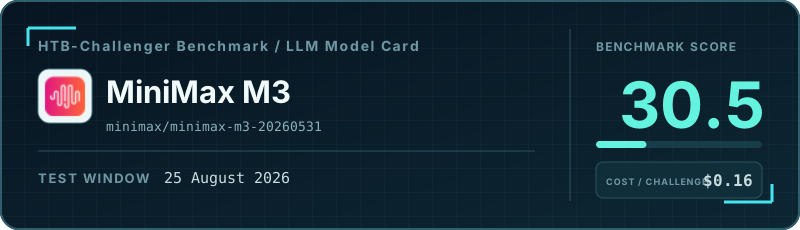
Its $0.16 median cost per challenge was not especially high across the full benchmark, but the value was weak compared with nearby peers. GPT-5.6 Luna scored 31.6% at a median cost of $0.02, while Hy3 scored 34.8% at $0.08. Given M3’s low score and high rate of stuck runs in these tests, there is not much positive I can say about its performance in this benchmark.
Cost vs. Benchmark Score
The highlighted point is this model. Models closer to the upper-left achieve a higher benchmark score at a lower median cost per challenge.
Overall benchmark results
- Number of challenges: 16
- Number of solved challenges: 7
- Number of false positives: 0
- Runs where the model gave up: 0
- Runs that reached the step or cost limit: 1
- Runs where the model got stuck: 8
- Benchmark score: 30.5%
| Metric | Per challenge (median) | Total |
|---|---|---|
| Model steps | 26.5 | 593 |
| Model cost | $0.16 | $3.08 |
| Duration | 00:07:45 | 02:46:11 |
| Number of input tokens | 0.36M | 13.14M |
| Number of output tokens | 0.07M | 1.57M |
Number of read_file tool calls |
0.0 | 24 |
Number of write_file tool calls |
0.0 | 32 |
Number of execute_command tool calls |
23.5 | 615 |
Number of web_search tool calls |
0.0 | 5 |
Results by challenge difficulty
All resource-usage metrics are medians per challenge.
| Metric | Very Easy | Easy | Medium | Hard |
|---|---|---|---|---|
| Results | ||||
| Number of challenges | 4 | 4 | 4 | 4 |
| Number of solved challenges | 3 | 2 | 2 | 0 |
| Number of false positives | 0 | 0 | 0 | 0 |
| Runs where the model gave up | 0 | 0 | 0 | 0 |
| Runs that reached the step or cost limit | 0 | 0 | 0 | 1 |
| Runs where the model got stuck | 1 | 2 | 2 | 3 |
| Benchmark score | 61.7% | 47.9% | 49.0% | 0.0% |
| Median per challenge | ||||
| Model steps | 61 | 19 | 12 | 27.5 |
| Model cost | $0.29 | $0.14 | $0.07 | $0.21 |
| Duration | 00:13:23 | 00:09:34 | 00:04:09 | 00:07:45 |
| Number of input tokens | 1.01M | 0.15M | 0.14M | 0.75M |
| Number of output tokens | 0.11M | 0.11M | 0.04M | 0.07M |
Number of read_file tool calls |
2.0 | 2.5 | 0.0 | 0.0 |
Number of write_file tool calls |
0.0 | 1.0 | 0.0 | 0.0 |
Number of execute_command tool calls |
47.0 | 21.0 | 10.0 | 32.5 |
Number of web_search tool calls |
0.0 | 0.0 | 0.0 | 0.0 |